
Herbal extracts appear in many forms. Understanding a few label basics can help you compare products more carefully and make more informed choices.
Understanding Dietary Supplement Labels: What to Look For
The front of a supplement bottle is designed to help you identify the product. The side or back of the package is where much of the practical information lives.
Learning to read that information can make supplement shopping less dependent on slogans and more dependent on specifics.
Begin with what the product says it is
U.S. dietary supplement labels are required to identify the product as a dietary supplement or with an equivalent description, such as an herbal supplement.
That sounds basic, but it is a useful first step: distinguish the product category from the marketing language surrounding it.
A colorful product name may be memorable. The statement of identity tells you what kind of product you are actually looking at.
Find the serving size
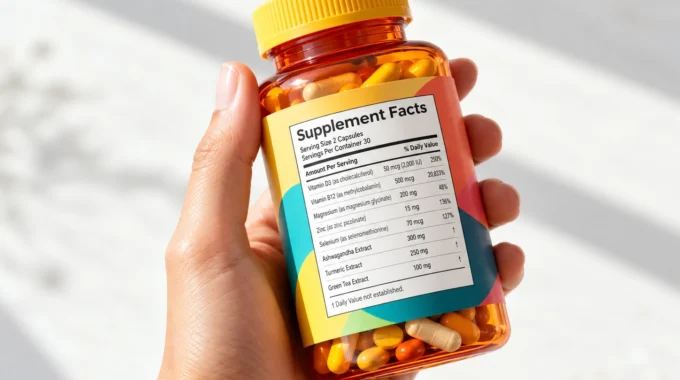
The Supplement Facts panel tells you the serving size and the number of servings in the container.
This matters because the amount of an ingredient is generally presented in relation to a serving.
If a bottle contains 60 capsules but the serving size is two capsules, the bottle represents 30 servings, not 60.
That is a simple detail that can change how you understand both the ingredient amounts and the practical length of use.
Read the ingredient amounts carefully
The Supplement Facts panel lists dietary ingredients and, where required, the amount per serving.
For nutrients with an established Daily Value, you may also see a percentage Daily Value (%DV). FDA explains that %DV helps show how much a nutrient in a serving contributes to a total daily diet.
Not every dietary ingredient has an established Daily Value. When no Daily Value has been established, the label may indicate that rather than presenting a percentage.
The important point is to read the amount and the unit — milligrams, micrograms, international units where applicable, or another declared measure — rather than relying on the visual size of a number alone.
What about proprietary blends?
A proprietary blend is a specific labeling category.
FDA requires the Supplement Facts panel to identify the blend and list its total amount per serving. Individual dietary ingredients in the blend are listed, generally in descending order by weight, but the amount of each individual ingredient within the proprietary blend does not have to be separately declared.
That is different from saying the formula is patented.
“Proprietary” and “patented” are not synonyms.
A consumer reading a proprietary blend should understand what the label does and does not disclose: it identifies the ingredients in the blend and the total amount of the blend, but may not reveal the exact amount of every individual component.
Don't skip “Other Ingredients”
Not everything in a supplement belongs in the Supplement Facts panel.
FDA requires ingredients that are not declared there to appear in an “Other Ingredients” list. Depending on the product, this might include capsule materials, flavors, stabilizers, preservatives, sweeteners, colors, or other components used to make the finished product.
If you are trying to understand the full composition of a supplement, read both sections.
Suggested use is different from Supplement Facts
The Supplement Facts panel tells you what is in a serving. Suggested-use directions tell you how the manufacturer instructs consumers to use the product.
Those are different pieces of information.
Do not assume that the number of capsules in a bottle, the amount of an ingredient, or a serving size tells you everything about how the product is intended to be used.
Learn to recognize different kinds of claims
Supplement labels can contain different categories of claims, and the distinctions matter.
FDA describes health claims, nutrient content claims, and structure/function claims as different categories governed by different requirements.
A structure/function claim generally describes how a nutrient or dietary ingredient may affect the normal structure or function of the body. It is not permission to claim that a supplement diagnoses, treats, cures, or prevents a disease.
When certain structure/function or general well-being claims appear in dietary supplement labeling, they are accompanied by the familiar FDA disclaimer explaining that the statement has not been evaluated by FDA and that the product is not intended to diagnose, treat, cure, or prevent disease.
That disclaimer should not be interpreted as FDA approval of the claim. In fact, the point is the opposite: FDA does not pre-approve these structure/function claims before they are used.
Look beyond the biggest words
Package design naturally emphasizes selected information.
A better reading order is:
- What is the product?
- What is the serving size?
- Which dietary ingredients are listed?
- How much is present per serving?
- What appears under Other Ingredients?
- What are the suggested-use directions and cautions?
- Who manufactures, packs, or distributes the product?
That sequence turns the label into a source of information rather than a collection of headlines.
Labels can also be researched
The NIH Office of Dietary Supplements maintains the Dietary Supplement Label Database (DSLD), which catalogs information from a large number of supplement labels sold in the United States.
It can be useful when you want to examine label information or learn more about ingredients. The database includes label images, ingredient names and forms, ingredient amounts, and label statements for products in its collection.
One final distinction
A label can tell you a great deal about what a product contains and how it is presented.
It cannot tell you whether a particular supplement is appropriate for your individual medical situation.
If you take medications, have a medical condition, are pregnant or nursing, or have questions about whether a supplement is appropriate for you, that is a conversation to have with a qualified healthcare professional.
Reading the label is not a substitute for medical advice. It is simply one of the best ways to become a more informed consumer.
Product Identity
Example Supplement
Supplement Facts
Serving Size1 unit
Example IngredientAmount shown on actual product label
Other Ingredients
See actual product label
Suggested Use
See actual product directions
Business Contact
See manufacturer or distributor information
Sources & Further Reading
Related Posts