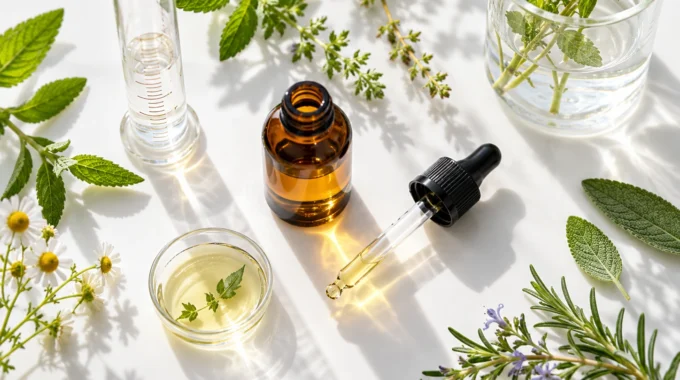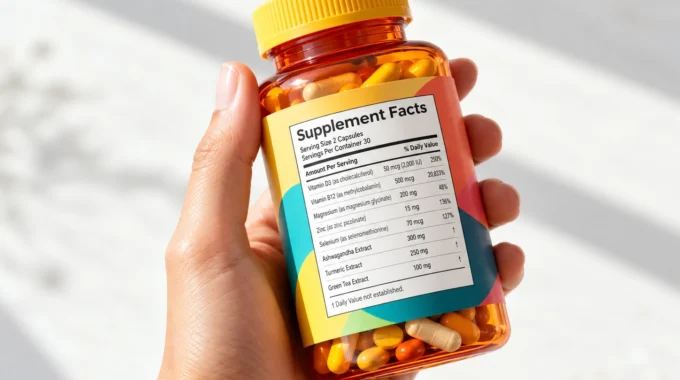

Herbal extracts appear in many forms. Understanding a few label basics can help you compare products more carefully and make more informed choices.
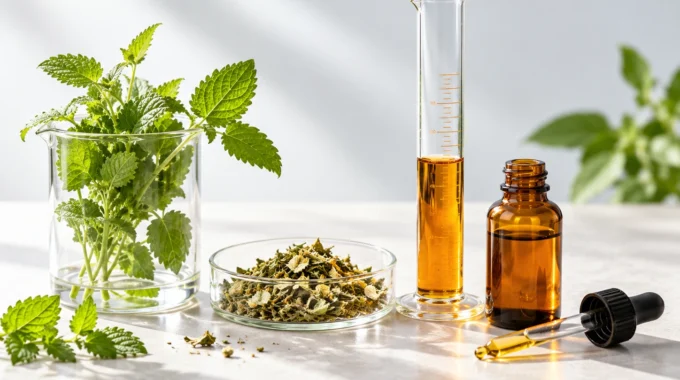
The Science Behind Herbal Extracts: From Plant to Tincture
Herbal extracts can sound mysterious.
A plant goes into a liquid, time passes, and a tincture or extract comes out. Without context, the process can feel closer to old-fashioned alchemy than modern manufacturing.
The basic science is much less mysterious.
Extraction is a way of separating selected chemical constituents from plant material by using a liquid — often called a solvent — in which some of those constituents can dissolve.
Plants are chemically complex
A leaf is not one substance.
Neither is a root, flower, seed, fruit, or piece of bark.
Botanical material contains many naturally occurring compounds with different chemical properties. Some dissolve readily in water. Others are more soluble in alcohol or another suitable solvent. Some are present in very small amounts. The exact composition can also vary with plant species, plant part, growing conditions, harvest, storage, and processing.
This is why “the herb” and “an extract of the herb” are not automatically identical materials.
The preparation method matters.
Extraction begins with solubility
A familiar kitchen example is coffee.
Ground coffee contains many compounds. When hot water passes through it, some compounds dissolve into the water and become part of the drink. The spent grounds still contain material that did not move into the cup.
Botanical extraction follows the same general scientific principle: contact a plant material with a suitable liquid so that selected constituents move from the plant into that liquid.
The solvent matters because chemicals differ in solubility.
Water is highly polar and is effective at dissolving many polar compounds. Ethanol has different chemical properties. A mixture of water and ethanol can therefore extract a different range of constituents than water alone.
That does not mean one solvent is universally “better.” The appropriate extraction system depends on the botanical material and what the manufacturer is trying to produce.
Why tinctures commonly use alcohol and water
The NIH Office of Dietary Supplements describes a tincture as a botanical soaked in a solution of alcohol and water.
That combination has two practical roles.
First, it creates an extraction medium with properties different from water alone. Second, alcohol can also contribute to preservation of the finished liquid.
The plant material, alcohol concentration, water content, extraction time, temperature, and ratio of plant to liquid can all influence the resulting preparation.
A tincture is therefore not simply “herbs in a bottle.” It is the result of a formulation and process.
Ratios help describe concentration — but they are not a ranking system
Tinctures and extracts may be described with botanical-to-extract ratios.
At a basic level, a ratio relates the amount of starting botanical material to the amount of finished extract.
That can help describe how a preparation was made.
But a ratio should not be treated like horsepower, where the larger number automatically means a better product.
Two extracts with different plants, plant parts, solvents, moisture levels, or manufacturing specifications cannot necessarily be compared by one number alone.
Concentration is information. It is not proof of effectiveness.
Extraction is followed by separation
After the plant has been in contact with the extraction liquid for the intended period, the liquid portion must be separated from the remaining plant material.
Depending on the manufacturing method, that can involve pressing, filtration, settling, or other controlled processes.
The result may be kept as a liquid extract.
Alternatively, the solvent can be partially or substantially removed to produce a more concentrated liquid or a dry extract that can later be incorporated into capsules, tablets, powders, or other dosage forms.
This is why “extract” describes a family of preparations rather than one single format.
Quality depends on more than the extraction step
Even a well-designed extraction process begins with a basic question: what plant material went into it?
Botanical identity matters.
So do the plant part, raw-material specifications, handling, and manufacturing controls. Finished-product quality can also involve testing and specifications appropriate to the ingredient and product.
The word “standardized” is sometimes used in botanical products, but consumers should not assume that the word alone guarantees quality or consistency. NCCIH specifically cautions against treating terms such as “standardized,” “verified,” or “certified” as automatic guarantees.
Specific documentation matters more than reassuring vocabulary.
Chemistry does not equal a health claim
This distinction is essential.
Science can explain how extraction works without proving that the finished extract produces a particular health outcome.
Knowing that a solvent removes certain constituents from plant material is chemistry.
Determining whether a specific finished product is safe and effective for a particular use is a different scientific question. It can require analytical testing, pharmacology, clinical research, and other evidence appropriate to the claim being evaluated.
One should not be substituted for the other.
A beautifully controlled extraction process does not, by itself, establish that a supplement treats a disease or produces a particular clinical benefit.
“Natural” still means chemically complex
There is sometimes an artificial divide between “natural” and “chemical.”
But plants are made of chemicals too.
NCCIH notes that herbal supplements can contain dozens of chemical compounds and cautions that natural does not necessarily mean safe.
That is not an argument against botanicals. It is an argument for treating them seriously.
Botanical products deserve the same kind of careful thinking we apply to other complex materials: What is it? How was it prepared? What does it contain? How consistent is it? What evidence supports the specific claims being made?
The simple scientific idea
Strip away the terminology and the basic process is understandable:
Plant material contains many constituents.
A selected solvent contacts that material.
Some constituents dissolve into the solvent.
The liquid is separated from the remaining plant material.
The resulting extract is kept liquid, concentrated, or dried depending on the intended finished form.
That is the science at the center of a tincture or botanical extract.
It is not magic, and it is not proof of a medical effect.
It is a controlled way of moving selected plant constituents from one material into another form — and understanding that process makes botanical products easier to discuss with both curiosity and appropriate skepticism.
Plant materialPreparationSolvent contactSeparation/filtrationFinished liquid or dry extract
Sources & Further Reading
Related Posts